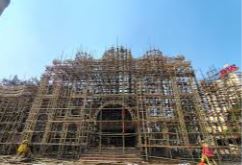
When the festive season arrives, the transformation of neighbourhoods across India can be remarkable. Streets light up, markets become crowded and Durga Puja pandals begin to take shape. Behind these spectacular structures, however, lies an industry that often remains out of the spotlight — the bamboo economy.
For generations, bamboo has been an essential part of Durga Puja preparations. Today, its role is evolving. As pandals become more ambitious, designers and artisans are combining traditional bamboo craftsmanship with modern technology, innovative engineering, lighting systems and digital design. What was once seen simply as a natural construction material is increasingly becoming part of a much larger creative and economic ecosystem.
Bamboo: The Backbone Behind Many Pandals
A Durga Puja pandal may look like an artistic wonder once it is illuminated, but its foundation often begins with bamboo.
Artisans use bamboo poles and strips to create frameworks, arches, walls, decorative elements and intricate backdrops. In many traditional pandals, bamboo also forms the structural base on which fabric, paper, cloth and other decorative materials are added.
The connection between bamboo and Durga Puja is deeply rooted in tradition. Bamboo is associated with the initial rituals and structural preparation of several pandals, while skilled craftsmen use thin bamboo strips to create decorative frameworks and traditional backdrops.
The work also generates demand for a wide range of supporting activities — from bamboo harvesting and transportation to cutting, treatment, weaving, construction, painting, decoration and dismantling.
From Traditional Craft to Tech-Enabled Pandal Making
The biggest change in recent years is the way technology is entering the pandal-making process.
Large theme-based pandals increasingly begin with digital sketches and computer-aided designs. Designers can visualise structures before construction begins, calculate dimensions and plan decorative elements with greater precision.
Modern lighting has also transformed the final appearance. LED systems, programmable lights, sensors, projection mapping and digital displays can turn a bamboo framework into an immersive visual experience.
This does not mean technology has replaced traditional craftsmanship. Instead, the two are increasingly working together.
A bamboo artisan may create the physical structure, while an architect or designer develops the theme digitally. Electrical teams install sophisticated lighting, technicians manage digital effects and decorators complete the traditional finishing work.
The result is a new form of festive production where craft, creativity and technology meet.
A ₹28,000-Crore Opportunity
The potential of the bamboo economy extends far beyond festivals.
According to the Government of India, the country’s bamboo and rattan industry is valued at around ₹28,005 crore. India has about 13.96 million hectares under bamboo, with 136 bamboo species, including 125 indigenous species.
The National Bamboo Mission is supporting cultivation, processing and marketing across 24 States and Union Territories. As of December 2024, the programme had supported 408 bamboo nurseries, 104 treatment and preservation units, 528 product development and processing units and 130 market infrastructure facilities.
These numbers show why bamboo is increasingly being viewed as an economic resource rather than simply a traditional craft material.
Festivals Create Seasonal Income
The festive economy can provide an important seasonal market for bamboo growers and artisans.
As demand rises before Durga Puja, different groups benefit at different stages. Farmers and bamboo suppliers provide raw material. Local traders arrange transportation. Artisans process and shape the bamboo. Pandal makers construct the framework. Designers, painters, electricians and decorators then add their specialised skills.
The economic chain does not end when the puja begins. After the celebrations, bamboo and other materials can be dismantled, reused or redirected into other applications, depending on their condition.
This makes the festival season an important example of how a cultural event can create a temporary but extensive network of livelihoods.
Odisha and the Wider Bamboo Opportunity
The bamboo story is particularly relevant for states such as Odisha, where efforts are underway to develop bamboo cultivation, value addition and bamboo-based industries.
The Odisha Bamboo Development Agency highlights commercial bamboo cultivation, value-added products, technology-based processing and cluster development as part of its approach to strengthening the sector. It also places emphasis on improving returns for farmers and creating sustainable livelihoods for rural communities and women.
This opens opportunities beyond pandals — including furniture, handicrafts, construction materials, packaging, lifestyle products and other modern applications.
Why Bamboo Could Become a Festive Green Business
Bamboo’s attraction is not only cultural. Its rapid growth and wide range of applications have made it an important part of discussions around sustainable materials and the green economy.
The Asian Development Bank in 2026 approved a $42.2 million financing facility to support bamboo-industry development in India’s northeastern states, with a focus on value chains, rural livelihoods, women’s participation and digital solutions.
This indicates that bamboo is increasingly being viewed through the lens of organised industry, investment and technology.
For the festive economy, this creates an interesting opportunity: traditional bamboo craftsmanship can be connected with modern design, better processing, digital marketing and organised supply chains.
From Pandal Material to Economic Opportunity
The next time a beautifully illuminated Durga Puja pandal catches attention, it is worth looking beyond the lights and decorations.
There may be farmers behind the bamboo, artisans who shaped it, transporters who moved it, designers who planned the structure, technicians who installed the lighting and small businesses that supplied the materials.
That is the hidden economic story of the festive season.
Bamboo may begin as a simple green stem, but during the festive season it can become a structure, a piece of art, a source of employment and, increasingly, a technology-enabled business opportunity.
As India’s festival economy grows more sophisticated, the humble bamboo could find itself at the centre of a new opportunity — where tradition meets technology, craftsmanship meets entrepreneurship, and culture creates livelihoods.