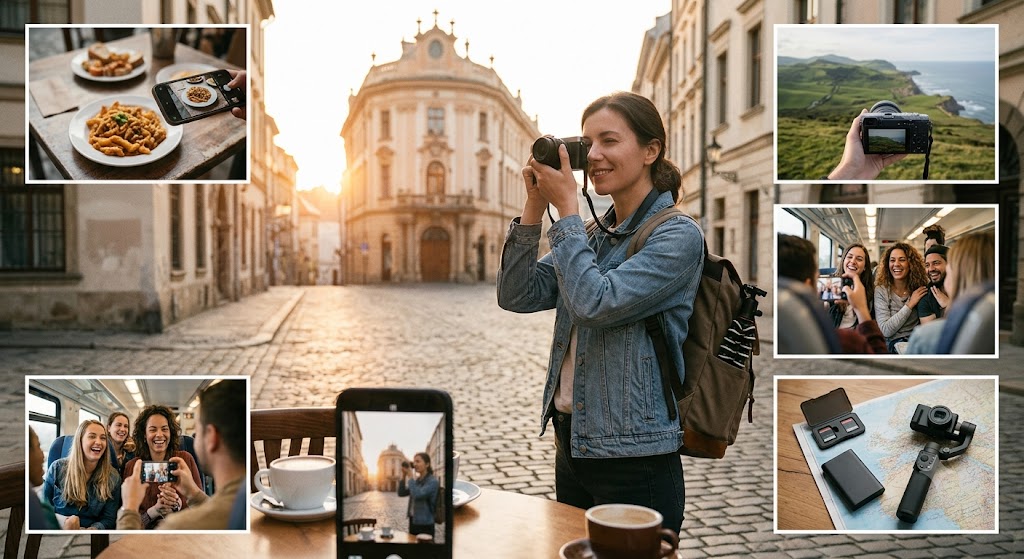
Travel is often remembered through the little things, the first sunrise at a new destination, a quiet street, a local meal, a beautiful landscape or a spontaneous moment shared with family and friends.
A camera helps preserve these experiences long after the journey is over. Today, travellers have many choices, from smartphones and compact cameras to lightweight mirrorless cameras and simple accessories that make photography easier on the road.
The best travel camera, however, is not always the most expensive one. It is the one that is easy to carry, comfortable to use and ready when a memorable moment appears.
Smartphones Keep Travel Photography Simple
For most travellers, the smartphone remains the easiest photography companion. It is always available and can capture everything from landscapes and portraits to food and street scenes.
Modern smartphones offer better low-light photography, image stabilisation and automatic processing, allowing users to take attractive photographs without worrying about complicated settings.
For a relaxed holiday, a smartphone may be all you need. Its biggest advantage is simplicity — capture the moment, edit it if you wish and share it with friends and family.
Compact Cameras Offer a Different Experience
Compact cameras are also becoming popular again among travellers who want something more dedicated than a smartphone. Their small size makes them easy to carry, while larger sensors and dedicated lenses can provide greater control and image quality.
The renewed interest in compact travel cameras reflects a simple preference: many people want better photographs without carrying a heavy camera bag. Recent 2026 camera guides continue to highlight compact models for their balance of portability and image quality.
For street photography, city holidays and everyday travel, a compact camera can be an elegant middle ground between a phone and a professional camera system.
Mirrorless Cameras for Photography Lovers
For travellers who enjoy photography and want more creative freedom, a lightweight mirrorless camera can be a good choice.
These cameras allow users to change lenses and control settings such as exposure, aperture and shutter speed. They are particularly useful for landscapes, portraits, wildlife and photographs taken in changing light.
The latest travel-focused recommendations continue to favour smaller mirrorless cameras because they offer a strong combination of image quality and portability.
But carrying a larger camera should never come at the cost of enjoying the trip. If the equipment feels like a burden, it may end up staying in the hotel room.
Small Accessories Can Make a Big Difference
Travel photography does not require a suitcase full of equipment. A few simple accessories can make the experience easier.
A lightweight tripod can help with sunrise and sunset photographs, night scenes and group pictures. A power bank is useful during long days of sightseeing, while extra memory cards can prevent the frustration of running out of storage.
For travellers who enjoy making videos, a small gimbal or pocket camera can help capture smoother footage while walking through markets, streets and scenic locations.
A comfortable camera strap or small camera bag can also make carrying equipment easier during a full day of exploring.
Choose the Camera According to Your Journey
There is no single camera that is perfect for every traveller.
If your priority is convenience, a smartphone is a natural choice. If you want better image quality without carrying much equipment, a compact camera may be ideal. For photography enthusiasts who want greater creative control, a lightweight mirrorless camera offers more flexibility.
The choice should depend on the kind of journey you are planning, rather than simply choosing the most powerful equipment.
The Most Important Tool Is Your Eye
Good travel photography is not only about technology.
Sometimes the most beautiful photograph is an unexpected moment — sunlight falling across an old building, a local vendor preparing food, children playing in a street or a quiet view from a train window.
The camera simply helps preserve what you noticed.
Taking a little time to observe the light, wait for the right moment and look beyond the obvious tourist attractions can make photographs feel more personal and meaningful.
Make Memories, Not Just Photographs
A holiday may last a few days, but its memories can stay with us for years. Photographs give those memories a visual form and allow us to revisit them whenever we want.
So, before your next journey, choose equipment that suits your style, keep it light and make sure your devices are charged and ready.
Most importantly, do not spend the entire trip looking through a screen.
See the place. Feel the moment. Then capture it.
Because the best travel photograph is not necessarily the most technically perfect one. It is the photograph that takes you back to a moment you never want to forget.