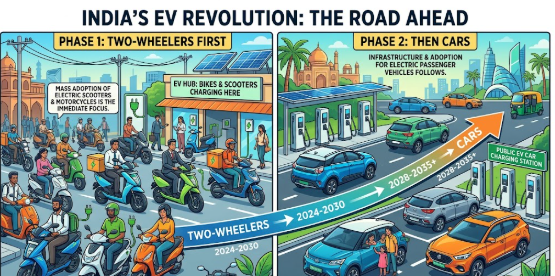
New Delhi, Aug 17: India’s electric mobility transition is likely to follow a distinctly different path from Europe and the US, with two-wheelers and auto-rickshaws expected to lead the first phase of electrification, while passenger cars gradually become a larger driver of demand, according to an analysis.
The analysis highlights that India’s transport system is far more diverse than those of many Western economies. Two-wheelers, auto-rickshaws, buses, trains and passenger cars serve different mobility needs, and each segment is expected to shift to electric power at a different pace.
This means India’s EV transition is unlikely to happen as one sweeping change. Instead, it is expected to develop in stages, with each vehicle category creating different requirements for batteries, minerals and charging infrastructure.
Two-wheelers likely to lead the first wave
According to the analysis, the first major phase of India’s electrification is expected to come from two-wheelers and auto-rickshaws, which dominate everyday mobility in the country.
These vehicles are used extensively for commuting, last-mile connectivity and livelihoods. Their rapid electrification could therefore bring electric mobility into the daily lives of millions of people.
As these markets mature, however, the source of EV growth is expected to change. Increasingly, demand could come from replacing older vehicles rather than expanding the overall vehicle fleet.
This would mark a natural progression in India’s EV journey—from rapid initial adoption towards a more mature replacement market.
Passenger cars could shape long-term demand
The analysis points to a different trajectory for passenger cars.
Car ownership in India is expected to continue expanding well beyond 2050. As the number of cars grows and electrification increases, passenger vehicles are expected to account for a growing share of battery demand and consumption of critical minerals.
As a result, India’s EV transition could become progressively more material-intensive, even as overall vehicle growth eventually begins to stabilise.
The analysis also highlights the expected increase in demand for critical minerals such as lithium, copper, nickel and cobalt as millions of electric vehicles enter Indian roads over the coming decades.
However, this pressure will not emerge uniformly. India’s diverse vehicle mix means mineral demand is likely to build in different phases as individual segments electrify.
Charging infrastructure will have to evolve
The changing vehicle mix will also determine India’s charging requirements.
According to the analysis, demand for slow chargers could increase six to nine times by 2030, driven largely by two- and three-wheelers.
Fast chargers, meanwhile, are expected to continue expanding as passenger-car electrification gathers pace and could remain an important part of the charging ecosystem well into the following decades.
The analysis therefore points to the importance of planning charging infrastructure for the future vehicle mix, rather than simply building capacity around today’s requirements.
A different path could create new opportunities
India’s gradual and diverse electrification pathway could also support the development of a wider electric-mobility ecosystem.
As different vehicle categories move towards electrification, demand could grow for charging infrastructure, batteries, components and related technologies. The changing requirements of two-wheelers, three-wheelers and passenger cars could also encourage businesses to develop solutions specifically suited to the Indian market.
The analysis suggests that India’s EV transition should therefore be viewed as a long-term transformation of the country’s mobility system rather than simply a shift from petrol and diesel cars to electric cars.
India’s EV journey will unfold in stages
The analysis presents a picture of an EV transition that will evolve over decades.
Two-wheelers and auto-rickshaws are expected to drive the early phase, while passenger cars could become increasingly important to battery and critical-mineral demand over the longer term. At the same time, charging infrastructure will need to expand and adapt as the composition of India’s EV fleet changes.
This phased transition could allow India to develop its electric-mobility ecosystem alongside changing consumer and transport needs.
India may not be following the same EV roadmap as the West—but according to the analysis, its diverse vehicle landscape could ultimately make the country’s transition one of the world’s most distinctive journeys towards electric mobility.