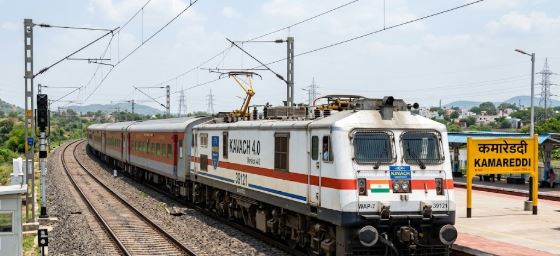
Indian Railways is stepping up its use of indigenous safety technology with the first commissioning of KAVACH Version 4.0 on the South Central Railway network, marking a significant upgrade in the country’s automatic train protection capabilities.
The latest version has been commissioned across 108 route kilometres between Malkajgiri and Kamareddi in the Hyderabad Division. The deployment builds on the experience of KAVACH Version 3.2 and introduces a range of technological improvements aimed at making train operations safer, more reliable and more responsive.
Technology designed to support safer train journeys
KAVACH is an indigenously developed Automatic Train Protection system that works as an additional layer of safety for locomotive pilots. It continuously supports train operations by monitoring speed limits, signal conditions and other operational requirements.
If a train approaches a danger signal or exceeds the permitted speed and the required corrective action is not taken, the system can automatically apply the brakes. This capability is particularly important in reducing the risk of Signal Passing at Danger (SPAD) and helping maintain safe distances between trains.
The system can also provide additional support during difficult operating conditions, including situations involving poor visibility or challenging weather.
KAVACH 4.0 brings sharper location and signalling capabilities
The latest version incorporates several upgrades designed to improve the accuracy and reliability of train protection.
One of the key improvements is enhanced location accuracy, enabling the system to determine a train’s position more precisely. Accurate positioning is particularly important for timely safety interventions and effective train movement management.
KAVACH 4.0 also offers improved real-time signal aspect display in larger railway yards. Such areas can have complicated signalling arrangements, and clearer information can help locomotive pilots better understand the operational environment.
The upgraded system further strengthens communication through station-to-station optical fibre cable connectivity. This provides a more reliable communication network for exchanging critical information between railway locations.
Another important feature is its ability to interface directly with existing Electronic Interlocking systems, allowing train protection and signalling infrastructure to work more closely together.
Building on experience from earlier deployment
The introduction of Version 4.0 comes after extensive operational experience with KAVACH 3.2 on South Central Railway. The earlier version has already been deployed across around 1,465 route kilometres, providing valuable experience for further development of the technology.
The move to the newer version reflects the broader effort to continuously improve railway safety systems rather than relying on a single technological solution. As railway networks become increasingly busy and complex, automated systems can provide locomotive pilots and railway operators with additional support during critical situations.
Strengthening India’s indigenous railway technology ecosystem
The development of KAVACH also has significance beyond railway safety. As an Indian-developed technology, its expansion creates opportunities for domestic capabilities in signalling, electronics, telecommunications, software, automation and railway equipment manufacturing.
A wider rollout could support demand for specialised technology and equipment while encouraging further innovation in India’s railway technology ecosystem. It also demonstrates how locally developed solutions can be adapted and upgraded to meet the operational requirements of one of the world’s largest railway networks.
For passengers, however, the most important outcome remains straightforward: greater technological support for safer train operations.
With KAVACH 4.0 now entering operational use, the focus will increasingly be on expanding advanced automatic train protection across more routes, strengthening supporting infrastructure and improving system reliability.
The move represents another step towards a railway network where modern signalling, automation and indigenous technology work together to make train journeys safer and more dependable.