Aug 31: Most people assume plants reproduce by whatever pollen happens to land on them. This is not true. A collaborative research initiative involving the Indian Institute of Technology Gandhinagar has mapped and functionally tested the genes that control a natural “self-rejection” system in two widely grown Indian oilseed crops, Brassica rapa varieties toria and yellow sarson. This system governs the molecular ‘lock and key’ mechanism in certain mustard plants that allows them to reject their own pollen.
With India importing more than half of its edible oil, a dependence that met roughly 56% of domestic demand in 2023–24, and the Government pushing for self-reliance, the research could offer plant breeders and farmers a new foundation for producing high-yielding hybrid mustard.
The study, a collaboration with the Indian Council of Agricultural Research-Directorate of Rapeseed-Mustard Research, Bharatpur, was recently published in Frontiers in Plant Science.
Many flowering plants have a built-in system called self-incompatibility. Self-rejection or SI allows a flower to reject its own pollen and accept pollen from other plants. By refusing self-pollen, a plant forces cross-breeding, which mixes genes, avoids inbreeding, and produces offspring that are often hardier and more productive than either parent. This maintains genetic diversity and promotes hybrid vigour.
For agricultural breeders seeking to develop high-yielding hybrid seeds, this self-rejection system is a gift, sparing breeders the tedium of removing pollen by hand from thousands of flowers. Producing hybrid seeds on a commercial scale is difficult if the maternal plant destroys its own pollen, or conversely, if it self-pollinates accidentally before the breeder can introduce the partner line.
“To maximise crop yields through hybridisation, we need precise control over pollination, which is aided by self-rejection,” said Dr Subramanian Sankaranarayanan, the study’s corresponding author and Assistant Professor at IITGN’s Department of Biological Sciences and Engineering. “Though SI has been extensively studied in Brassica napus (canola), the molecular basis of this mechanism is poorly characterised in India’s commercially grown Brassica rapa varieties, toria and yellow sarson.”
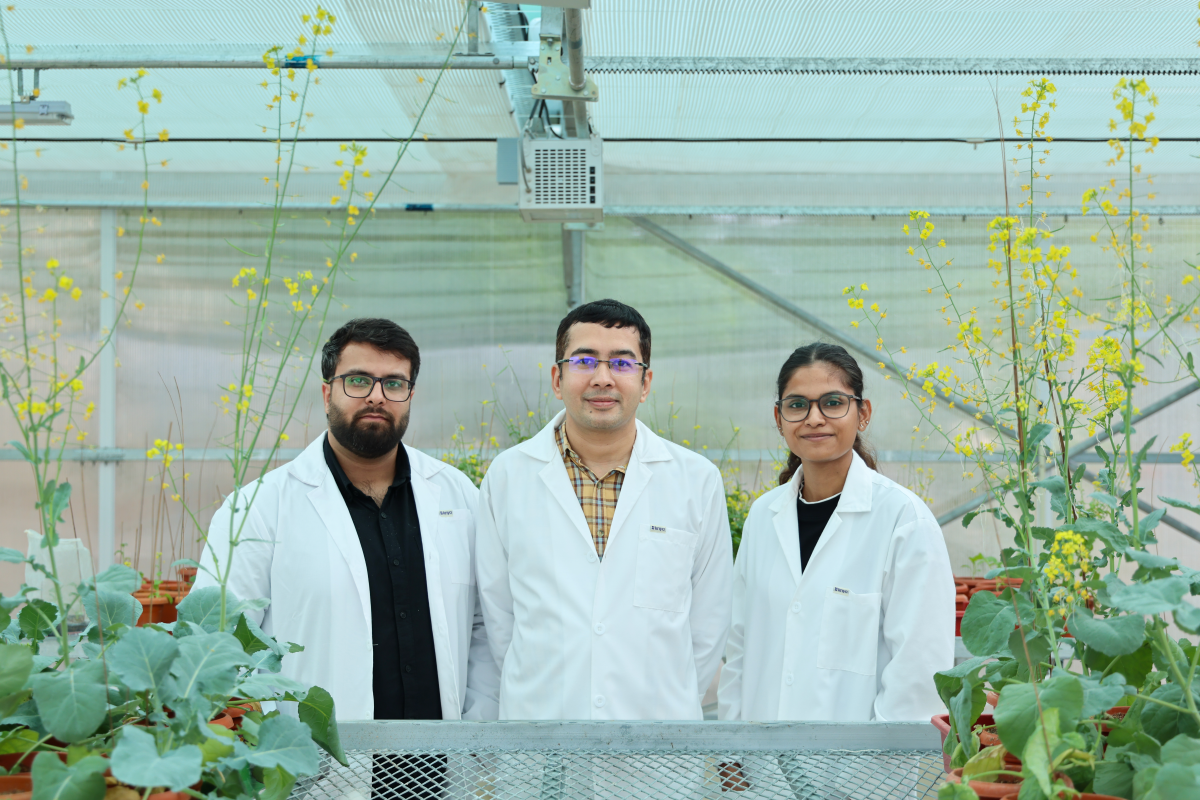
The IITGN team, led by Dr Sankaranarayanan, with co-first authors Hemal Bhalla and Kumari Ankita, and colleagues, Aman Ahlawat, and Surabhi S Rode, decided to study the pollination process in the aforementioned plants. Toria rejects its own pollen, demonstrating self-incompatibility, whereas yellow sarson accepts it, demonstrating self-compatibility.
The molecular ‘lock-and-key’ mechanism determining these outcomes is located on the surface of the plant’s female reproductive tissue, the stigma. Through controlled pollination experiments, the researchers first established the compatibility relationships between the two varieties by analysing pollen attachment, pollen tube growth and seed development. In self-pollinated toria, almost nothing grew, while in the crosses, the flowers filled with growing tubes.
Next, the team combined molecular biology with computational analysis to characterise SRK, FER1, MLPK, and ARC1. These four major genes code for proteins that act as the cellular sensors, processors, and executors of the plant’s self-rejection response. The team cloned and sequenced these genes and compared their genetic codes, or spellings, with those of related plants to build family trees. They were able to confirm that the genes were genuine, well-conserved versions of the known self-rejection genes rather than lookalikes.
Because a gene’s job depends on the shape of the protein it produces, they also modelled those shapes. Here, they used AlphaFold3, an artificial-intelligence tool from Google DeepMind that predicts a protein’s three-dimensional structure. Think of it as generating a detailed blueprint of each molecular machine, which lets the team check that every protein carries the right working parts to do its expected job.
In addition to their structure, the researchers also aimed to confirm the function of these genes by temporarily switching off each gene, one at a time. They did this with short, custom-made strands of synthetic DNA that latch onto a specific gene’s instructions and stop the cell from acting on them. Crucially, this silencing is temporary and leaves no permanent change in the plant. The strands were simply dripped onto the flower’s stigma, and the team then watched whether the flower’s behaviour changed.
When they muted SRK, FER, or ARC1, toria’s self-rejection collapsed, and the flower began accepting its own pollen. Fluorescence microscopy confirmed robust pollen tube growth, proving that the self-incompatibility barrier had been breached.
The study also yielded a surprising discovery regarding MLPK. “Traditionally, this gene is considered vital to the self-rejection pathway in related mustard species,” explained Hemal Bhalla, co-first author and a PhD Scholar at IITGN’s Department of Biological Sciences and Engineering. “But, in toria, switching off MLPK only partially weakened the rejection response, indicating it plays a secondary or redundant role in this specific variety.”
The researchers also mapped a second defence the flower deploys by monitoring biochemical changes on the stigma surface within minutes of pollination. When an incompatible pollen grain lands, the plant deploys a localised chemical shield of Reactive Oxygen Species. These are reactive molecules that halt pollen germination, which they measured using Nitro Blue Tetrazolium, a dye that darkens wherever those reactive molecules gather. Silencing SRK, FER, or MLPK dulled the release of ROS, while silencing ARC1 did not. This suggested that the flower operates two separate defence systems simultaneously, with ARC1 probably utilising an alternative cellular degradation pathway to neutralise unwanted pollen.
The researchers also showed that these genes are highly conserved across Brassica species, suggesting that the underlying molecular mechanism has remained largely unchanged during evolution. The structural analyses revealed that the proteins possess conserved functional domains consistent with their roles in pollen recognition and signalling.
The authors note that their work establishes a foundation and that permanent gene editing and transgenic validation remain future steps. Cross-tests confirmed that toria and yellow sarson still interbreed successfully, with the resulting seeds showing near-complete germination — an important signal that the system is usable in real breeding programmes.
As climate change accelerates, bringing erratic monsoons, unseasonal heatwaves, and shifting pest pressures to the Indian subcontinent, the ability to breed hardier oilseeds quickly has taken on real economic weight. India’s heavy reliance on imported edible oil leaves both farmers and households exposed to global price shocks. Developing specialised, climate-resilient hybrid oilseeds is a crucial step towards achieving the targets of the National Mission on Edible Oils – Oilseeds and the United Nations Sustainable Development Goals 2 and 12 .
“Our findings provide a clear molecular blueprint of how pollination is governed in India’s oilseed varieties,” noted Kumari Ankita, co-first author and a PhD Scholar at IITGN’s Department of Biological Sciences and Engineering. “Foundational genetics like this creates an execution pipeline for developing hybrids that are stacked with favourable traits, including higher oil content, disease resistance, and resilience to erratic weather.”
The research was supported by numerous fellowships and grants from IITGN and the Government of India, including the Ministry of Education Prime Minister Research Fellowship, the University Grants Commission, the Department of Biotechnology, the DBT Ramalingaswami Re-entry Fellowship, and the Science and Engineering Research Board Start-up Research Grant.