
Education is one of the most powerful tools for social and economic development. In a country as diverse and populous as India, providing equal access to quality higher education remains a significant challenge. Every year, millions of students aspire to pursue undergraduate and postgraduate degrees, but many face barriers such as financial limitations, geographical distance, a shortage of educational institutions, and family or work responsibilities.
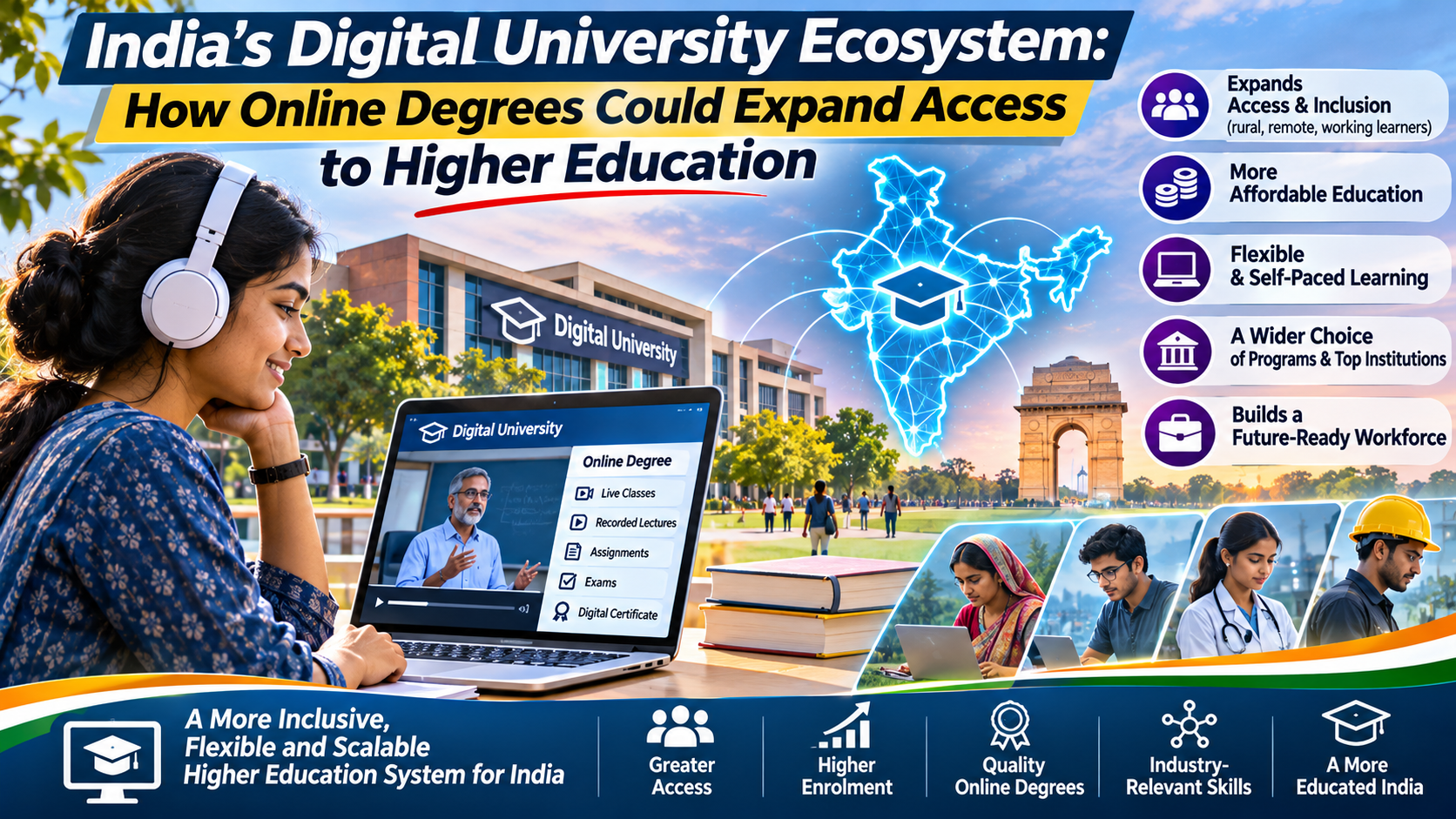
The rapid growth of digital technology is creating new opportunities to address these challenges. India’s emerging digital university ecosystem has the potential to transform the traditional education system by making higher education more accessible, affordable, flexible, and inclusive. Through online degree programmes, digital learning platforms, virtual classrooms, and technology-enabled academic resources, students can pursue higher education without necessarily relocating or attending a physical campus.
Digital universities are not simply an alternative to conventional colleges. They represent a new approach to education that could help India build a more skilled, knowledgeable, and digitally empowered population.
Understanding India’s Digital University Ecosystem
India’s digital university ecosystem consists of online education platforms, universities offering recognised online programmes, digital academic resources, virtual learning environments, and government-supported educational initiatives.
The National Education Policy (NEP) 2020 has emphasised the importance of technology in improving the quality and accessibility of education. It encourages the use of digital learning tools, online courses, virtual laboratories, and technology-based teaching methods.
Several initiatives have already contributed to the development of India’s digital education infrastructure:
-
SWAYAM: A government-supported online learning platform offering courses from school to postgraduate levels.
-
SWAYAM PRABHA: A group of educational television channels providing learning content to students across the country.
-
National Digital Library of India: A digital repository that provides access to a wide range of academic resources.
-
Academic Bank of Credits (ABC): A digital system that enables students to accumulate, store, and transfer academic credits, subject to applicable regulations.
-
Digital University initiative: An initiative announced in the Union Budget 2022–23 to provide access to world-class quality universal education through digital learning.
Together, these initiatives are helping create an interconnected learning environment in which students can access educational opportunities beyond the limitations of traditional classrooms.
How Online Degrees Can Expand Access to Higher Education
1. Breaking Geographical Barriers
One of the biggest challenges in India’s higher education system is the unequal distribution of educational institutions. Students living in rural areas, remote villages, and economically disadvantaged regions often have limited access to quality colleges and universities.
Online degree programmes can help overcome this geographical divide. Students can attend lectures, access study materials, participate in discussions, and complete assignments from their homes.
For example, a student living in a remote village in Odisha may be able to pursue a recognised online degree from a university located in Delhi, Mumbai, or Bengaluru without relocating. This can reduce travel and accommodation expenses while creating opportunities that might otherwise remain inaccessible.
2. Making Higher Education More Affordable
The cost of higher education is another major concern for Indian families. Traditional education often involves tuition fees, accommodation, transportation, books, and other living expenses.
Online learning can reduce several of these costs. Students may access digital textbooks, recorded lectures, online assessments, and virtual academic resources at relatively lower expenses.
This affordability can be particularly beneficial for students from low-income households who wish to continue their education without placing additional financial pressure on their families.
However, affordable education must also include access to reliable internet connections, suitable devices, and quality academic support.
3. Creating Opportunities for Working Professionals
Many individuals discontinue their education because of employment, family responsibilities, or financial commitments. Traditional university programmes may not offer the flexibility they need.
Online degree programmes allow working professionals to study alongside their jobs. They can attend recorded lectures, complete assignments during their available hours, and pursue additional qualifications without leaving their employment.
This flexibility is particularly important in today’s competitive job market, where continuous learning and skill development are increasingly necessary.
4. Promoting Inclusive Education
Digital universities can create opportunities for groups that have historically faced barriers to higher education, including women, persons with disabilities, first-generation learners, and students from underserved communities.
For women in areas where travelling to distant institutions may be difficult, online learning can provide an additional route to higher education. Similarly, accessible digital content, captions, screen-reader compatibility, and flexible learning schedules can support students with disabilities.
Nevertheless, digital education must be designed with accessibility and inclusion in mind so that technology does not create new forms of inequality.
5. Supporting Lifelong Learning and Skill Development
The modern employment market is changing rapidly due to artificial intelligence, automation, digital transformation, and emerging industries. As a result, individuals need to update their knowledge and skills throughout their professional lives.
Online universities can offer degree programmes, professional certifications, specialised courses, and interdisciplinary learning opportunities in areas such as data science, business management, cybersecurity, digital marketing, and emerging technologies.
By combining academic knowledge with practical skills, digital education can help students become more adaptable and better prepared for changing employment opportunities.
The Role of Technology in Transforming Education
Technology is at the centre of India’s digital university ecosystem. Artificial intelligence, cloud computing, learning management systems, virtual laboratories, and interactive educational platforms are changing how students learn and how teachers deliver education.
Artificial intelligence can support personalised learning by identifying students’ learning needs and recommending suitable educational resources. Recorded lectures and interactive modules allow learners to revisit difficult topics at their own pace.
Virtual laboratories can provide practical learning experiences in selected subjects, while digital assessment systems can simplify examinations and academic evaluation.
Moreover, data-driven learning platforms can help institutions monitor student progress, identify learning difficulties, and provide timely academic support.
These technological developments can make higher education more interactive, flexible, and student-centred.
Challenges Facing India’s Digital University Ecosystem
Despite its enormous potential, digital higher education in India faces several challenges that must be addressed.
1. Digital Divide: Not every student has access to high-speed internet, smartphones, laptops, or reliable electricity. This creates unequal learning opportunities between urban and rural populations.
2. Quality of Education: Online degrees must maintain strong academic standards. Institutions need qualified faculty members, updated curricula, effective assessments, and proper student support systems.
3. Lack of Practical Exposure: Certain disciplines require laboratory work, clinical training, fieldwork, or hands-on experience. Fully online learning may not be sufficient for these subjects.
4. Digital Literacy: Many students and teachers lack the technical skills required to participate effectively in online education. Training and digital awareness programmes are therefore essential.
5. Recognition and Employment Acceptance: Students need confidence that their online qualifications will be recognised by employers and other educational institutions. Clear regulatory standards and quality assurance mechanisms are important.
6. Student Engagement: Online learners may experience isolation, reduced motivation, and limited interaction with teachers and classmates. Institutions must create opportunities for mentoring, collaboration, and academic counselling.
Addressing these challenges is necessary to ensure that digital education becomes a reliable and meaningful alternative to conventional learning.
Government Initiatives and the Way Forward
The Indian government has taken several steps to strengthen digital education through initiatives such as SWAYAM, the National Digital Library, the Academic Bank of Credits, and the National Education Policy 2020.
The University Grants Commission (UGC) also provides a regulatory framework for recognised online and distance learning programmes. Students should verify the recognition and eligibility status of a university and its specific programme before enrolling.
Moving forward, India needs greater investment in digital infrastructure, especially in rural and underserved regions. Affordable internet connectivity, accessible learning devices, digital literacy programmes, and regional-language educational content should become important priorities.
Universities should also develop partnerships with industries to ensure that online degree programmes remain relevant to changing employment requirements. Combining online learning with practical training, internships, research opportunities, and academic mentoring can further improve the quality of digital education.
The Future of Online Degrees in India
The future of India’s digital university ecosystem looks promising. As internet connectivity improves and digital technologies become more accessible, online education could become an important part of the country’s higher education framework.
Hybrid learning models, which combine online instruction with physical academic experiences, may offer an effective balance between flexibility and practical exposure.
Digital universities could also encourage students to pursue interdisciplinary education, combine academic credits from different recognised institutions, and develop specialised skills according to their interests and career goals.
However, the success of this transformation will depend not only on technological advancement but also on educational quality, institutional accountability, affordability, and equal access.
India’s ambition to become a global knowledge economy will require a higher education system that is flexible, inclusive, and capable of responding to the needs of a changing society.
Conclusion
India’s digital university ecosystem has the potential to reshape the future of higher education by bringing learning opportunities closer to millions of students. Online degrees can reduce geographical and financial barriers, support working professionals, promote inclusive education, and encourage lifelong learning.
Initiatives such as SWAYAM, the Academic Bank of Credits, and the Digital University vision reflect the country’s growing commitment to technology-enabled education.
Nevertheless, digital transformation must not come at the cost of educational quality or equality. Bridging the digital divide, strengthening academic standards, improving digital literacy, and ensuring the recognition of online qualifications will be essential.
Ultimately, the goal should not be to replace traditional universities but to create a more flexible and interconnected education system in which every deserving student has the opportunity to learn, grow, and succeed.