Aug 31: Carbon dioxide is usually discussed as something the world needs to get rid of. Activities such as the burning of fossil fuels for daily use, like electricity and transportation, and industrial applications, release significant amounts of CO₂, and the gas enters the atmosphere. Researchers are now asking whether this road could have a roundabout. What if CO₂, which is at the centre of the climate crisis, could be turned into something useful and put back into the industrial cycle?
Scientists have been exploring electrochemical reduction as one such effort because it can be powered by renewable electricity and operates under mild water-based conditions. The end products of conversion include useful chemicals.
One promising destination is carbon monoxide, an important building block for the chemical industry. The challenge is that CO₂ is a very stable molecule under normal conditions. Its carbon and oxygen atoms are held together very tightly! Hence, it is crucial to find a catalyst that can coax the stubborn molecule into reacting without demanding large amounts of energy.
As an effort in this direction, researchers from the Indian Institute of Technology Gandhinagar have proposed two-dimensional materials, which could make the conversion from CO₂ to CO easier with exceptionally low energy requirements. Their findings were published in npj Computational Materials.
What makes the study particularly interesting is that the researchers have brought together two strategies that had previously largely been explored separately:
-
MBenes, which are extremely thin, layered, two-dimensional materials made from a metal atom and the element boron. Their unusual structure gives them a large exposed surface, making them great candidates for enhanced chemical reactions.
-
High-entropy materials, which use mixtures of several metals to create a chemically diverse surface that can aid different steps of a catalytic reaction.
MBenes are related to the more widely studied MXenes, nanomaterial sheets that conduct electricity similar to metals and mix easily with water. MBenes have a boron centre that can tune the electron supply to the adjacent metal layer, helping the surface transfer charge into CO₂ and activate the otherwise resistant molecule.
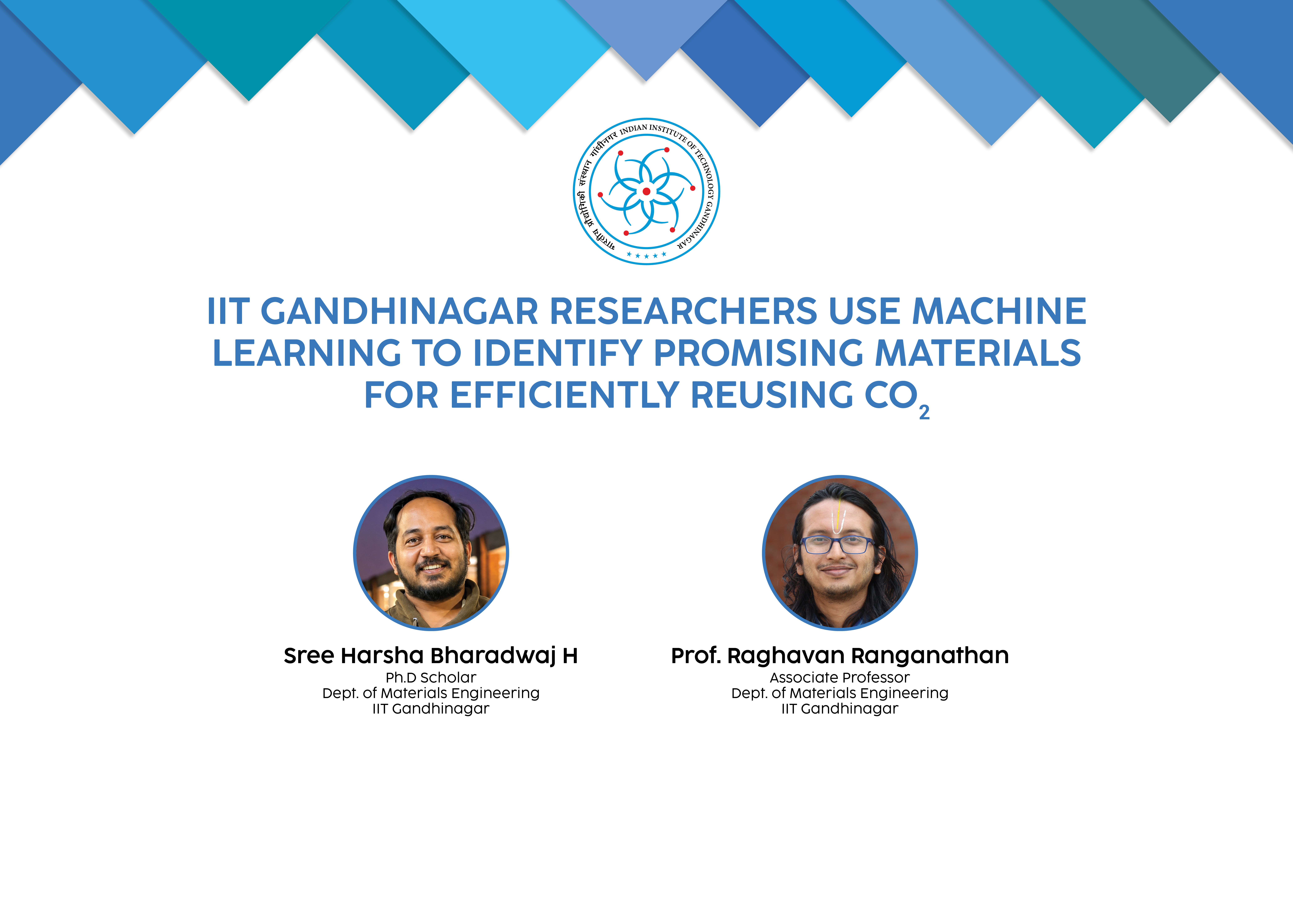
According to Sree Harsha Bharadwaj H,
“While previous studies have identified promising MBene catalysts, they generally require an extra electrical boost or generate more complex products such as methane and methanol.” The first author of this study, Mr Sree Harsha, is a fourth-year PhD scholar in the Department of Materials Engineering at IITGN. “Hence, we thought about combining the positives of MBenes with those of high-entropy alloys and explored high-entropy MBenes for CO₂ reduction,” he continued. As an advantage, the present research focuses on generating CO, a key intermediate for converting captured CO₂ into fuels and industrial chemicals.
Out of the 18 compositions that emerged as viable candidates after a series of computational screening simulations, three high-entropy MBenes that stood out converted CO₂ efficiently without needing any extra electrical push. They contain five-metal combinations of chromium, niobium, zirconium, molybdenum, titanium, hafnium, and tantalum, along with boron.
Imagine trying to open a tightly sealed jar. Gentle force would not help. On the other hand, severe force may either damage the jar or spill its contents. What is needed is the right amount of grip and force. That is where the five-metal design of the three high-entropy MBenes potentially has an advantage.
The researchers found that the metals appear to divide up the work, in accordance with the well-known “cocktail effect” in multi-element systems. For example, chromium acts as the preferred site for CO₂ adsorption, while zirconium and hafnium help supply electrons to the site. Together, this creates a favourable environment that can activate the conversion of CO₂. The output, CO, can function as a valuable raw material to make a wide range of fuels and chemicals, such as syngas, in controlled industrial settings. Syngas can generate electricity and power fuel cells, among other functions.
In the words of Dr Raghavan Ranganathan, “This possibility is thought-provoking as such approaches may contribute to a future in which captured CO₂ can be circulated back into the economy. While our calculations establish a promising picture, future studies should consider experimental synthesis and electrochemical testing.” Dr Ranganathan is an Associate Professor in the Department of Materials Engineering and the Principal Investigator at the Computational Molecular Engineering Group.
The promise of such materials aligns with the efforts of India’s Department of Science and Technology, which has identified carbon capture, utilisation and storage as a crucial pathway towards net-zero emissions by 2070. The researchers acknowledged the Param Ananta supercomputing facility at IITGN, supported by the National Supercomputing Mission.