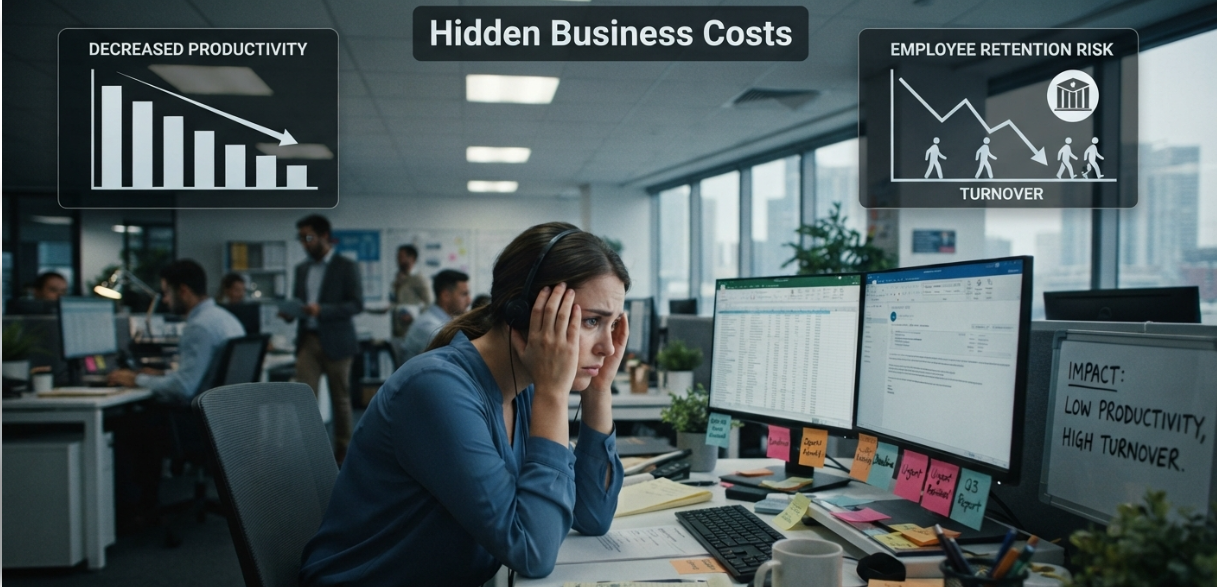
An employee who repeatedly checks a report for mistakes, a team that regularly works late to meet deadlines, or a manager who notices declining performance may be seeing more than the usual pressures of work. Sometimes, these are signs that workplace stress is becoming difficult to manage.
Workplace anxiety is often treated as an individual problem. Employees are expected to manage their time better, remain motivated and learn to handle pressure. But what happens when that pressure comes from unrealistic deadlines, unclear expectations, job insecurity or a workplace where people are afraid to make mistakes?
For businesses, the consequences can extend beyond employee well-being. Persistent stress may affect concentration, decision-making, teamwork and staff retention. The resulting costs are not always immediately visible in financial statements, but they can influence productivity, customer service and long-term business performance.
The Business Cost of Workplace Anxiety
The World Health Organization estimates that depression and anxiety contribute to approximately 12 billion lost working days globally every year, costing the world economy around US$1 trillion in lost productivity.
These figures highlight why mental well-being deserves attention from business leaders, not just human resources teams.
The impact goes beyond employees taking sick leave. Some continue working while feeling overwhelmed, but struggle to concentrate, organise tasks or make decisions efficiently. This is known as presenteeism—being at work while functioning below one’s usual capacity.
An employee may spend excessive time reviewing a document out of fear of criticism, postpone a decision because they are worried about making a mistake or find it difficult to focus on routine tasks. One such incident may have little impact, but when these patterns affect an entire team, delays and repeated work can disrupt operations.
For smaller businesses, the effects can be particularly difficult to manage. When a team has limited staff, one employee struggling with their workload can place additional pressure on colleagues, creating a cycle of stress across the organisation.
What Recent Workplace Reports Reveal
The financial and human consequences of workplace stress are increasingly receiving attention in global research.
The International Labour Organization’s 2026 report, The Psychosocial Working Environment: Global Developments and Pathways for Action, estimates that work-related psychosocial risk factors contribute to more than 840,000 deaths annually and economic losses equivalent to approximately 1.37% of global gross domestic product. These risks include long working hours, job insecurity, excessive demands and workplace bullying or harassment.
The findings highlight an important distinction: workplace well-being is influenced not only by how individuals respond to pressure, but also by how jobs are designed, workloads are managed and employees are treated.
India’s workplace data offers another perspective. Gallup’s State of the Global Workplace 2026 report found that 28% of surveyed employees in India experienced stress a lot of the previous day. The comparable global figure was 40%.
These figures measure reported daily stress, not clinically diagnosed anxiety, and do not establish that work was the sole cause. Nevertheless, they highlight the importance of understanding the pressures employees experience and whether workplace practices are contributing to them.
For employers, the message is clear: when stress becomes a regular part of working life, it is worth examining the work environment rather than expecting employees to manage every challenge on their own.
How Anxiety Can Affect Productivity and Decision-Making
Most jobs involve deadlines, difficult decisions and periods of high pressure. Problems can arise when employees have little opportunity to recover or feel that they must remain constantly available.
Anxiety can make it harder to concentrate, organise tasks and make decisions confidently. Some employees may repeatedly check completed work because they fear criticism. Others may postpone important decisions or rush through assignments to avoid missing deadlines.
This can create a frustrating cycle. Pressure makes it harder to focus, mistakes create additional work, and the growing backlog increases pressure further.
The solution is not always to introduce stricter deadlines or demand faster results. Businesses may need to review priorities, distribute responsibilities more fairly and ensure employees have sufficient time and resources to complete their work.
Why Workplace Anxiety Can Increase Employee Turnover
When employees feel overwhelmed or unsupported for long periods, they may begin to question whether their workplace is right for them.
Some start looking for other jobs. Others gradually withdraw from team activities, lose interest in their responsibilities or stop sharing ideas. By the time an employee resigns, the problem may have been developing for months.
Replacing that employee requires time and money. Recruitment, onboarding and training all carry costs, while the departure of experienced staff can disrupt workflows and affect customer relationships.
Remaining employees may also have to absorb additional duties during the transition. If the underlying workplace problems are not addressed, new recruits could eventually face similar difficulties.
Employee retention, therefore, is more than a recruitment concern. It can also reflect how effectively a business manages workloads, leadership, communication and workplace culture.
The Role of Workplace Culture
The amount of work matters, but so does the environment in which it is done.
Imagine working in a team where priorities change without explanation, mistakes are criticised publicly and messages are expected to be answered late at night. Even a skilled and committed employee may find it difficult to work confidently in such an environment.
Now consider a workplace where responsibilities are clear, managers offer constructive feedback and employees can raise concerns without fear of being blamed. The work may still be demanding, but people have a better chance of managing that pressure.
A supportive culture does not mean removing deadlines or lowering performance standards. Businesses need accountability and results. What matters is whether expectations are reasonable, feedback is fair and employees have the support needed to meet their goals.
What Businesses Can Do to Reduce Workplace Anxiety
Employers do not need to wait for productivity to decline or experienced employees to resign before taking action. Practical changes can help create a healthier working environment.
1. Set realistic workloads and priorities
When every task is treated as urgent, employees can struggle to decide what deserves their attention first. Managers should establish clear priorities, review workloads regularly and set deadlines that reflect the time and resources available.
2. Help managers recognise stress
Managers are often the first to notice changes in an employee’s behaviour or performance. Training in communication, active listening and supportive supervision can help them respond constructively instead of adding to the pressure.
3. Encourage employees to speak openly
Employees should be able to raise concerns about workloads, unclear responsibilities or inappropriate behaviour without fearing retaliation. Regular one-to-one conversations, confidential feedback channels and fair grievance procedures can help build trust.
4. Respect boundaries between work and personal time
Routine messages outside working hours and expectations of constant availability can make it difficult for employees to disconnect. Clear communication policies can help distinguish genuine emergencies from tasks that can wait until the next working day.
5. Make appropriate support accessible
Counselling services, employee assistance programmes and reasonable workplace adjustments can help employees who need additional support. These services should complement, rather than replace, efforts to address working conditions that may be creating unnecessary pressure.
The World Health Organization recommends combining organisational interventions with manager training, employee education and appropriate support for people experiencing mental health difficulties.
How Businesses Can Recognise Warning Signs
Workplace anxiety does not always announce itself clearly. Employers may notice rising unplanned absences, recurring errors, missed deadlines, staff complaints or increasing employee turnover without immediately recognising a common cause.
These signs do not automatically mean anxiety is responsible. They do, however, provide a reason to examine working conditions more closely.
Confidential employee surveys, regular feedback and discussions about workload can help managers understand whether expectations are realistic and whether employees have the resources they need. Businesses can then monitor whether changes to staffing, management practices or communication improve the situation.
This approach makes employee well-being part of everyday business management rather than an initiative that receives attention only during awareness campaigns.
A Healthier Workplace Is a Business Investment
Workplace anxiety can remain hidden for a long time. Employees may continue attending meetings, completing assignments and responding to customers even when they are struggling with constant pressure. The consequences may become visible only when performance declines, working relationships deteriorate or experienced staff leave.
Businesses cannot remove every challenge from working life. They can, however, avoid making demanding jobs harder through unclear instructions, unreasonable workloads or unsupportive management.
Clear expectations, fair treatment, realistic deadlines and access to support can help employees work with greater confidence. These measures can also help businesses retain talent, maintain continuity and deliver more consistent results.
Ultimately, workplace anxiety is not just an individual concern. It is also a business issue shaped by how people are managed and how work is organised. Recognising its hidden costs is an important step towards building workplaces where employees can perform well without sacrificing their well-being.