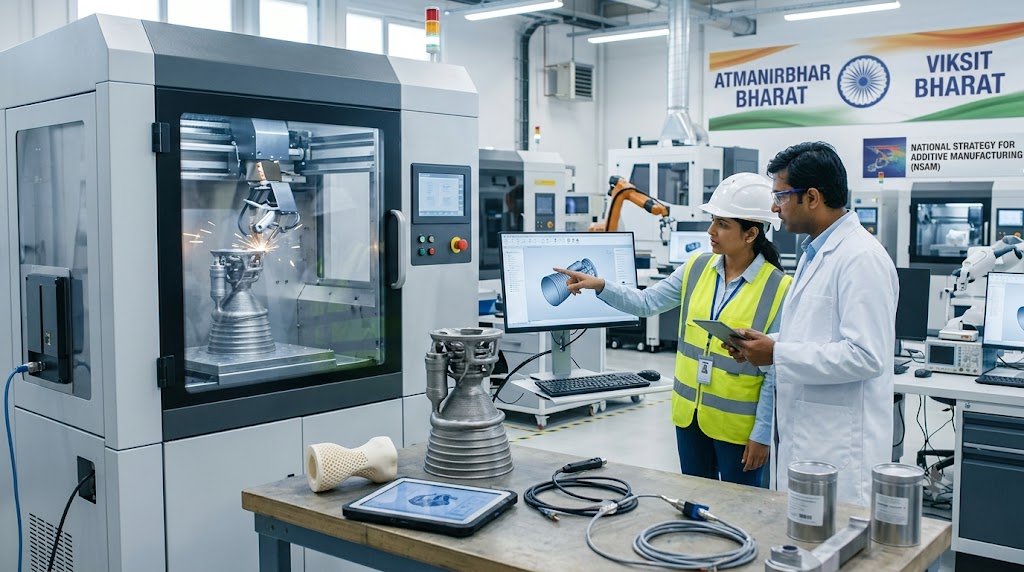
India’s manufacturing sector is gradually moving towards a more technology-driven model, with Additive Manufacturing (AM) emerging as an important part of this transformation. Better known as 3D printing, the technology allows manufacturers to create physical products layer by layer from digital designs, opening new possibilities for customised production, advanced engineering and faster product development.
Unlike conventional manufacturing, which often involves cutting, moulding or shaping materials, additive manufacturing builds components directly from digital models. This can be particularly useful for producing complex designs, specialised parts and prototypes that may be difficult or expensive to make using traditional methods.
India Builds a Strong Additive Manufacturing Base
The government has been working to develop a domestic ecosystem around the technology. The National Strategy for Additive Manufacturing (NSAM), launched in 2022, has focused on strengthening skills, supporting startups and encouraging wider adoption of the technology.
More than 1.54 lakh people have been trained under the initiative, while 56 additive manufacturing startups have received support. The next phase, NSAM 2.0, is expected to further integrate the technology into India’s broader manufacturing ambitions under Atmanirbhar Bharat and Viksit Bharat.
The focus is not simply on increasing the number of 3D printers. India is also looking to develop expertise in design, engineering, materials, software and machine development, creating a more complete manufacturing ecosystem.
A Growing Global Market
The global opportunity in additive manufacturing is expanding rapidly. The global AM machines market could reach around $149 billion by 2035, while the additive manufacturing-enabled electronics supply chain could grow from about $18 billion to $112 billion during the same period.
This expansion could create significant opportunities for Indian manufacturers and technology companies.
Areas such as polymers, metals, composites, ceramics and semiconductor-grade materials could become important growth segments as industries increasingly adopt advanced manufacturing techniques.
For India, developing capabilities in these areas could help domestic companies participate more actively in global supply chains rather than remaining dependent on imported specialised components.
From Rocket Engines to Defence Infrastructure
The technology is already finding applications in some of India’s most demanding sectors.
In May 2024, Agnikul Cosmos, an IIT Madras-incubated startup, launched Agnibaan SOrTeD, featuring a single-piece additively manufactured semi-cryogenic rocket engine. The development highlighted the potential of 3D printing in advanced aerospace applications.
Defence is another area where additive manufacturing is gaining attention. The Indian Army has developed a 3D-printed two-storey dwelling unit in Ahmedabad, reportedly completing the structure in just 12 weeks.
Such applications demonstrate how additive manufacturing can be useful when projects require customised designs, complex structures or faster production.
Healthcare Opens Another Door
The potential applications extend well beyond aerospace and defence.
Government-backed initiatives are also exploring 3D-printed bone grafts using indigenous bioceramic materials. One of the major advantages of such technology is the possibility of creating products designed for individual patient requirements.
If developed at scale, indigenous medical 3D printing could support personalised healthcare while reducing dependence on imported products and strengthening India’s medical manufacturing capabilities.
Why Digital Manufacturing Matters
The importance of additive manufacturing lies in its ability to connect digital design with physical production.
A product can be designed, modified and tested digitally before it is manufactured. This can make experimentation easier and could reduce some of the costs and time associated with traditional tooling, particularly for prototypes and specialised components.
The technology may also encourage more flexible and localised manufacturing. Instead of producing large quantities of every specialised component and maintaining extensive inventories, manufacturers could potentially produce certain parts closer to where they are needed.
For startups and smaller manufacturers, this flexibility could create new opportunities to develop and test products without making large investments in conventional production infrastructure.
Skills Will Drive the Next Phase
Technology alone will not determine India’s success in digital manufacturing. The country will also need a large pool of professionals who understand 3D design, material science, engineering, simulation, machine operation and quality control.
The training of more than 1.54 lakh people under the national strategy is an important step, but connecting these skills with real industry requirements will be equally important.
As adoption increases, demand is likely to grow for engineers, designers, researchers and technicians who can work across both digital and physical manufacturing processes.
Emerging Technologies in the Spotlight
India’s push towards advanced manufacturing will also receive attention at ESTIC-2026, scheduled from October 27 to 29. Organised by the Council of Scientific and Industrial Research (CSIR), the event is expected to bring emerging technologies, research and innovation into focus, including additive manufacturing.
Platforms such as these can help bring together researchers, startups, industry leaders and policymakers, creating opportunities for collaboration and technology development.
The Road Ahead
India’s manufacturing ambitions are increasingly moving beyond conventional production towards high-value, technology-intensive manufacturing.
Additive manufacturing could become an important part of this transition. Its applications already stretch from rocket engines and defence structures to healthcare and advanced industrial components.
The larger opportunity, however, is to build an ecosystem where digital design, advanced materials, software, engineering talent and manufacturing infrastructure work together.
If India can scale these capabilities, 3D printing could evolve from a specialised technology into a significant pillar of the country’s next manufacturing wave — helping Indian companies develop products not only for the domestic market but also for customers around the world.