
Sanpo-yoshi, a centuries-old business philosophy, could be a universal framework for sustainable business practices, suggests new study
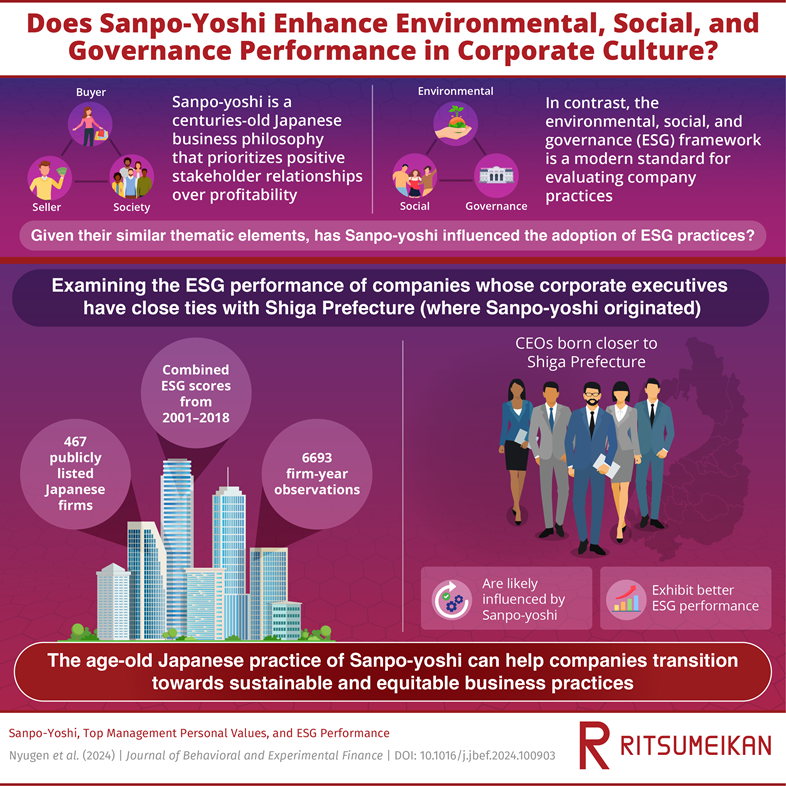
15th March 2024: Sanpo-yoshi, a traditional Japanese business philosophy prioritizing positive stakeholder relationships over profits, has stood the test of time. A recent study finds that corporate executives, who have been exposed to Sanpo-yoshi principles since childhood, tend to incorporate these practices into their business decisions, leading to better environmental, social and governance (ESG) performance. The findings highlight the positive influence of Japanese culture on promoting sustainable and ethical business principles.
There is a growing emphasis for corporations to consider their impact on the environment, society, and its stakeholders. Broadly falling under environmental, social and governance or ESG, this involves practices such as using sustainably sourced materials, reducing carbon emissions, improving labor practices, fostering positive community relations, and promoting ethical corporate behavior, including efforts against anti-competitive practices and corruption.
The first mention of ESG appears in a 2004 UN report titled “Who Cares Wins.” In contrast, the practice of conducting business ethically dates back centuries in Japan. In the 17th-19th centuries, Ohmi, merchants in Japan’s Shiga Prefecture (formerly Ohmi Province) practiced a business philosophy known as “Sanpo-yoshi.” This concept, translated as “three-way good,” signifies a way of conducting business to benefit buyers, sellers, and the society at large. The legacy and business philosophies of the Ohmi merchants still live on in Shiga Prefecture, where museums, breweries, and warehouses serve as reminders of the principles of Sanpo-Yoshi. Despite the intertwined concepts of Sanpo-yoshi and ESG, however, there is a paucity of research examining the impact of Sanpo-yoshi on a company’s ESG performance.
To fill this knowledge gap, a research team led by Associate Professor Pengda Fan from Ritsumeikan University, Japan, investigated whether the principles of Sanpo-Yoshi influenced the ESG performance of Japanese companies. Their findings were made available online on February 20, 2024 and published in Volume 41 of the Journal of Behavioral and Experimental Finance on March 01, 2024.
“Our research endeavors to not only illuminate the influence of ‘Sanpo-yoshi’ on ESG performance of Japanese firms, but also propagate the richness of Japanese culture on a global scale, akin to the international appreciation of Confucian culture” explains Dr. Fan.
A company’s policy is determined by the top management, consisting of CEOs and corporate executives. Often, these decisions are shaped by an individual’s personal experiences, cultural values, and attitudes. The researchers hypothesized that individuals in the top management exposed to the concept of Sanpo-yoshi could be more inclined to incorporate these principles into their firm’s decisions and actions, particularly those related to ESG.
In this vein, the researchers examined the ESG performance of 467 publicly listed Japanese firms between 2001 and 2018, for a total of 6693 firm-year observations. The ESG performance was evaluated using the ESG combined (ESGC) score, which considered the environmental, social, and governance pillar score along with the ESG controversies score. The ESG performance was merged with the data of the Board of Directors and CEOs to explore the correlation between the background of the top management and the firm’s ESG performance. They found that companies with a higher number of directors and CEOs associated with Shiga Prefecture exhibited better ESG performances. These findings were further validated using PSM and DID analyses, which corroborated the initial findings. The research group also evaluated the impact of the local political environment, top management’s prosocial attitude, key economic indicators, and female leadership on the correlation between Sanpo-yoshi and a firm’s ESG performance. They found that the above variables did not affect the primary findings and underscored the positive impact of the Sanpo-yoshi philosophy on ESG score.
Discussing the impact of their findings, Dr. Fan says, “We introduce a novel stakeholder-centric model that integrates the ethical principles of Sanpo-yoshi into the fabric of corporate governance. Our approach aims to elevate ESG metrics and foster inclusivity, transforming this age-old Japanese philosophy into a universal framework for sustainable and equitable business practices.”
Overall, the Sanpo-yoshi values can be promoted not only to improve the ESG performance of Japanese companies, but also to establish a global standard for responsible business practices.

