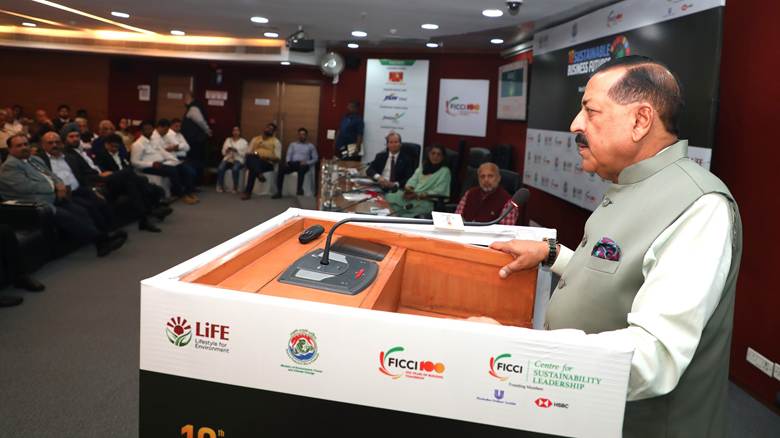
India, home to nearly 1.4 billion people, holds a pivotal role in the global transition towards a greener future, said Jitendra Singh, Union Minister of State (Independent Charge) for Ministry of Science and Technology and Ministry of Earth Sciences, while addressing the 10th Sustainable Business Futures Summit 2026.
The minister said that India stands at a decisive stage in the global shift towards a green economy, and its development trajectory will significantly influence the success of worldwide sustainability efforts.
“With a large share of the world’s population, India’s progress will play a critical role in shaping the outcome of the global green transition,” he said, adding that the country now has both an opportunity and responsibility to emerge as a leading driver of sustainable development powered by clean energy and green technologies.
Green Infrastructure as Growth Engine
Highlighting the country’s future growth strategy, Singh said green infrastructure will be a central pillar of India’s economic expansion in the coming decades. According to him, the global economy is increasingly moving towards recycling, regeneration and environmentally sustainable technologies, and India is aligning its development pathway with these priorities.
He noted that India’s economic journey over the past decade has been marked by a strong expansion of its innovation ecosystem. The country now hosts over two lakh startups, placing it among the world’s leading startup ecosystems.
Notably, nearly half of these startups are emerging from Tier-II and Tier-III cities, indicating a significant shift in entrepreneurial activity beyond traditional metropolitan hubs.
Clean Energy for Emerging Technologies
The minister also emphasised the need for a robust clean energy ecosystem to support emerging sectors such as data centres and artificial intelligence, which require reliable and continuous energy supply.
In this context, Singh highlighted the significance of the SHANTI Act, describing it as a major reform that opens India’s nuclear energy sector to wider participation, including private players, and enables the expansion of clean and dependable power generation.
Integrated Approach to Green Transition
India’s approach to sustainability, Singh said, is based on an integrated strategy that combines technological innovation, economic growth and environmental protection.
This includes:
-
Development of next-generation energy systems
-
Advanced energy storage technologies
-
Flexible and digitally enabled power grids capable of integrating multiple energy sources such as solar, wind, nuclear and hydrogen
-
Climate modelling and risk analytics
-
Sustainable construction technologies
Net Zero and Sustainable Lifestyles
Referring to policy direction from Narendra Modi, Singh reiterated that India has committed to achieving net-zero emissions by 2070. He also highlighted the importance of the Lifestyle for Environment (LiFE) initiative, which promotes sustainable consumption and environmentally responsible lifestyles.
According to the minister, this reflects India’s broader vision of inclusive and responsible growth aligned with global environmental priorities.
Circular Economy and Collaborative Action
Singh also underscored the growing importance of circular economy practices, noting that innovative waste-to-wealth initiatives are helping redefine the concept of waste by converting it into economic and environmental value.
Looking ahead, he said future infrastructure development must prioritise climate resilience, sustainable urban systems, clean mobility solutions and water security, supported by collaboration between government, industry and research institutions.
“The era of working in silos is over,” Singh said, stressing that collective action and partnerships will be critical for achieving long-term sustainability and building a green future.

