
– By Akash Pharande, Managing Director – Pharande Spaces
Indian home buyers are stretching their EMIs, their patience, and often whatever goodwill is left in their joint family WhatsApp groups. Everyone, with very few exceptions, now wants a big flat – even if it means longer, heftier EMI tenures. 3BHKs and above now get up to 50% of all property buyer demand. About a decade ago, it was just 30%.
Considering that property prices have also increased massively in the last ten years, that is NOT a small jump. Not surprisingly, developers are obligingly rolling out the required inventory. Flat sizes have grown across the board, and buyers just… absorb them.
There is no sign of shrinking ambition. Downgrading is firmly off the wish list. And no, this is not just another Insta phase that will peter out by the next monsoon. It is a very real, very visible shift in what Indians now want from and in their homes – space. Lots of it. As much as they can afford.
The trend has taken such a strong hold that there have actually been instances of some projects which had mostly smaller flats being converted to accommodate the demand for bigger homes.
Not among private builders who have already sold some parts of their projects – RERA makes it hard to just ‘scrap’ a small-flat project midway to turn it into one with bigger units without buy-in from their existing customers. But just this year, the Ghaziabad Development Authority (GDA) announced its intention to merge unsold smaller flats in schemes like ‘Madhuban Bapudham’ and ‘Indraprasth’ into bigger ones by knocking down the wall between two adjoining units – simply to revive stalled sales.
That’s the government, so not much complexity there. But private developers – and individual owners – who want to combine two adjacent flats into one larger ‘jodi’ flats, duplexes, or triplexes can only do so after getting a revised sanctioned plan from the municipal authority.
It’s worth mentioning that a previous pattern has actually reversed itself. Around 2016-2019, builders started reducing flat sizes and revamped their towers to include smaller 2 and 3BHK units because there was a lot of demand for such homes from budget-conscious first-time buyers.
What Actually Changed?
It is a popular notion that it was Covid-19 which brought on the ‘race for space’. However, that is not the case. This demand was already brewing, but the pandemic certainly did set it on fire.
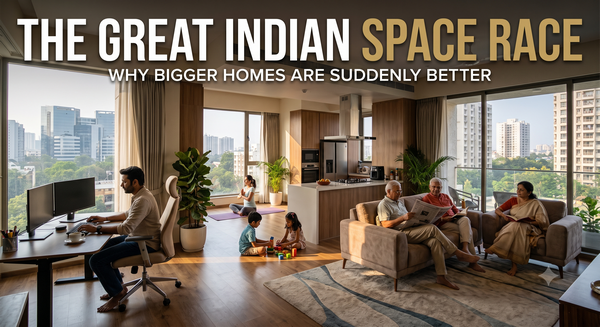
Before Covid, flats had been getting smaller for years. The main issues were an affordability crunch and the fact that millennials who were interested in homeownership at all (most still preferred renting back then – unlike now) wanted low-maintenance setups. After the lockdowns descended, living rooms suddenly became offices, classrooms and gyms. Not to mention a war zone every time two family members needed the space for different reasons.
Some reports suggest that the bigger flat size trend started picking up almost right after the first lockdown lifted. Because of WFH, studying from home, and no access to gyms, Indians suddenly realised that they needed room to breathe.
But as a developer, I can assure you that affordability was maxing out even before 2020. So, what has changed? Not people’s budgets. If anything, the pandemic pushed more hopeful Indian homebuyers to the financial brink than any other single event I the past few decades.
Many had to postpone their dream of homeownership altogether and settled for renting instead. Others who were not as seriously impacted by job losses bought whatever affordable housing remained. Thereafter, the demand equation changed drastically – the new motto was “if at all, then go big.” The right kind of supply naturally followed, as it always does.
Paying More… for More
Prices in the premium, larger-home segment have shot up seriously in the last 2-3 years – in some markets by 40% or more. Land has obviously become pricier, as have construction materials. According to real estate consultants Anarock, the residential sales value went up by almost 20%, even though the actual number of housing sales barely moved.
Basically, Indians are willing to shell out a lot more for more space. Additional space is not a ‘good-to-have’ any longer – it is now non-negotiable.
The Home Office That Ate the Hall
A dedicated study/work room is now one of the top requirements. Balconies, which had begun vanishing in the metros over the years, are now mandatory.
Homebuyers today ask harder questions like “What will the maintenance cost be?”, “Will this flat fetch a good price on the resale market?”, and “Show me exactly how far the school, mall and hospital are from here – ask your salesperson to drive me there.” It is now homebuying tempered with risk management.
Anyone who was locked in a small flat with three generations fighting over one router back in 2020 now looks at buying a home like they would look at any investment decision, but the investment is not only financial – it’s also lifestyle. This home must work for us today and five years from now, whatever we decide to do. Like take up consulting from home instead of working from an office, have two more kids like Mum so badly wants us to, or retire in comfort and security.
The ‘buy-small-now-upgrade-later’ mindset is gone. Covid certainly did do that. Now, it’s only about forever homes. The starter homes concept is gone – at least for now. But not in all cases.
Where Small Still Wins
Smaller homes still have plenty of takers. In fact, studio apartments have staged a major comeback and are one of the fastest-growing segments on the young-professional housing space. Such homes are cheap to maintain and often easier to commute to because projects with studios mostly come up in the crowded city centres, which have grown around workplace hubs.
Young professionals, newly married or about-to-marry couples, and retirees who have taken a conscious call to downsize are the primary buyers. Smaller flats don’t work for growing families, but they still do for singles, young couples, and empty-nesters who prefer convenience to large empty spaces.
Which Cities Are Actually Driving This Trend?
Smaller homes are now largely a big-city story. In smaller cities and towns where land is much cheaper, buying small makes no sense. Every city has its own version.
Mumbai is obviously the epicentre of ultra-luxury, big-format living. There, wealthy buyers look for sprawling apartments and duplexes despite the costliest per-square-foot prices in India. In Delhi-NCR and Bengaluru, the prices of larger premium homes have also shot up, and such units find ready takers among corporate honchos and tech start-up founders.
Pune has its very own version, because work-from-home is still very much a factor here. In PMC, buyers look for 3 and 4 BHKs with dedicated workspaces. In the sister city of PCMC, large-format homes in its many integrated townships are the fastest sellers.
And tier 2 cities continue to do brisk business in studio apartments and compact 1, 1.5 and 2 BHKs, thanks largely to their young working populations.
Are Developers Following the Bigger Homes Trend, or Steering It?
Developers in cities like Mumbai, Pune and Bengaluru have mostly gone all-in on projects dominated by larger, amenity-rich homes. The simple reason is that buyers there care more about space and flexibility than about mere affordability. It is also sound business – premium, large-format homes have better profit margins.
Is This a Passing Fad, or Here to Stay?
The demand for bigger homes is entirely structural – and reflects how both the modern work environment and the real estate market are evolving. Hybrid work models, a focus on wellness, and investment sense drive demand for bigger homes, as they attract more buyers and yield higher resale prices.
This trend is not about to change. If anything, the new focus on bigger homes will grow over the years – though, because of depleting land resources, new bigger homes may not be quite as big as today in the future. They will also become more expensive, and the cost factor will begin to affect an increasing segment of our cities’ otherwise well-to-do populations.
As for smaller affordable housing, the story is far more dire. The fact is that many of today’s first-time homebuyers are challenged to buy bigger homes and are gradually also getting priced out of the entry-level market segment. They can see the storm coming, so the ‘budget stretch’ that everyone keeps talking about is sometimes not a courageous lifestyle choice but plain survival mode.
If they miss this opportunity, buying a 2 BHK two years from now, even with hopes to upgrade later, will be impossible as property prices rise, salaries stagnate, and many tech jobs disappear. It’s literally now or never – and “if at all, then go big.”
About the author:
Akash Pharande is Managing Director of Pharande Spaces, a leading real estate construction and development firm famous for its township projects in Greater Pune and beyond. Pharande Promoters & Builders, the flagship company of Pharande Spaces and an ISO 9001-2000 certified company, is a pioneer of townships in the region.