New Delhi, Aug 13: India is taking another major step towards digital welfare delivery, with the government set to introduce Digital Rupee-based Direct Benefit Transfers (DBT) for food subsidies in Chandigarh and Dadra & Nagar Haveli on August 14.
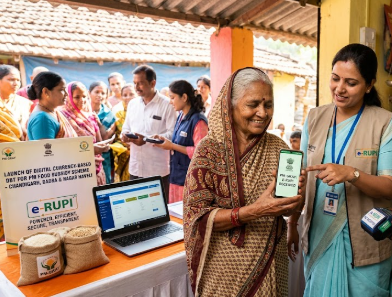
Under the new system, eligible beneficiaries of the Pradhan Mantri Garib Kalyan Anna Yojana (PMGKAY) will receive their food subsidy directly through Central Bank Digital Currency (CBDC) wallets.
The initiative is designed to make welfare payments faster, more transparent and easier to track, while reducing the need for traditional cash-based processes.
Chandigarh and Dadra & Nagar Haveli will become the first Union Territories to implement the CBDC-based food subsidy transfer for all eligible beneficiaries. The rollout builds on earlier pilot projects conducted in Puducherry and Gujarat.
Beneficiaries will be able to use Digital Rupee tokens to purchase foodgrains from authorised merchants. The digital payment system will provide a secure record of transactions, allowing subsidy utilisation to be monitored more effectively.
The initiative is also expected to strengthen financial inclusion by bringing more beneficiaries into the digital payments ecosystem and giving them access to simple wallet-based transactions.
For the government, the programme offers an opportunity to test how the Digital Rupee can support large-scale public welfare schemes. The experience gained could help develop similar digital payment models for other government programmes in the future.
The move reflects India’s broader push to use technology to make public services more efficient and citizen-friendly. By combining digital payments with welfare delivery, the initiative could help build a faster, more transparent and more accountable subsidy system.
The rollout is therefore being viewed as an important step in India’s journey towards a modern digital welfare ecosystem and the wider adoption of the Digital Rupee.