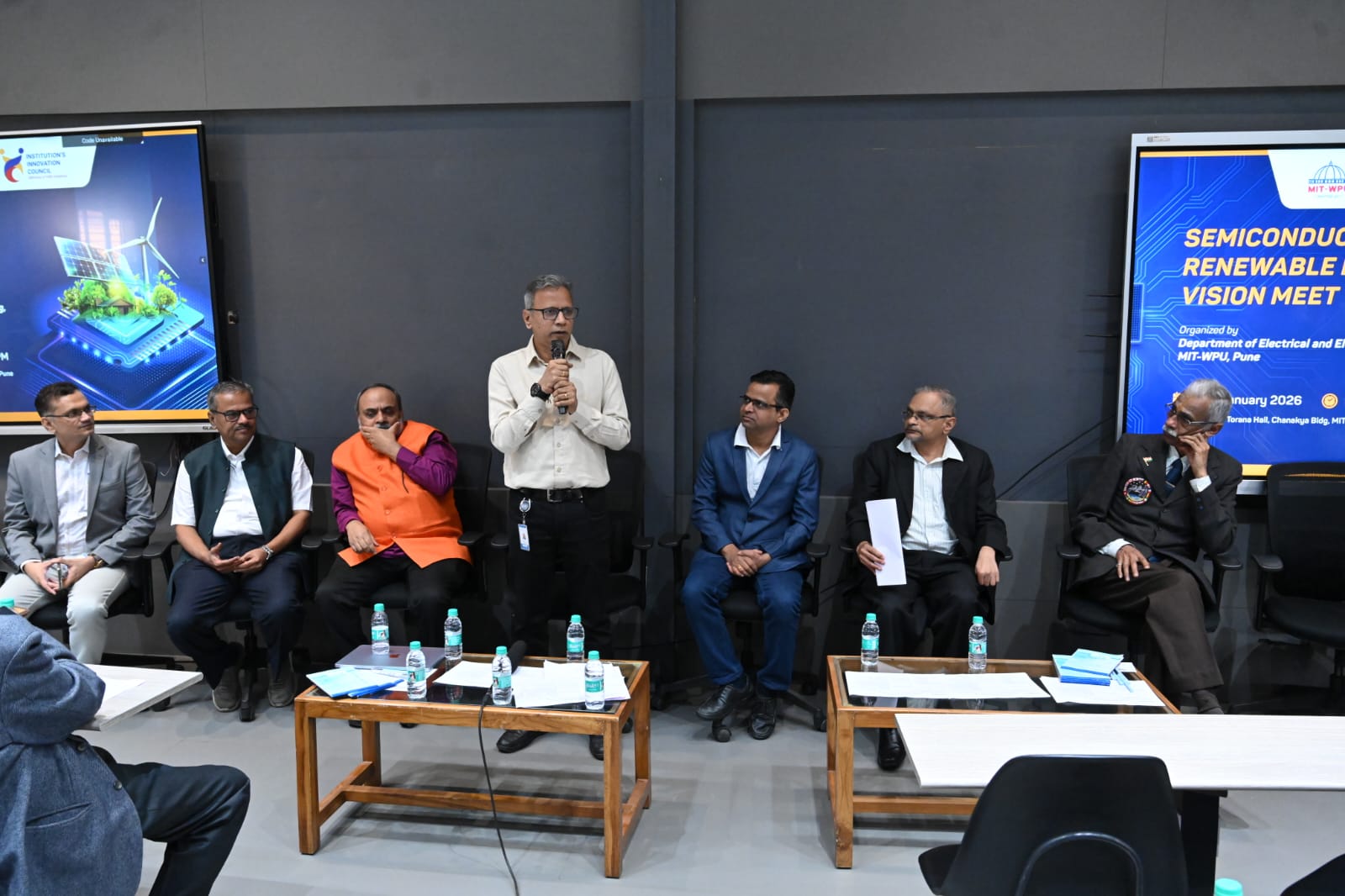
Mumbai/Pune, Jan 27: The next wave of technological leadership will not be driven by single-discipline experts, but by a new kind of professional who can think across boundaries said Dr. Satyam Priyadarshi, CEO of Reignite Future, USA who delivered keynote address at Semiconductor & Renewable Energy Vision Meet at MIT World Peace University (MIT-WPU) held recently at the university.
Elaborating on this shift, Dr. Priyadarshi introduced the concept of “AVATAR talent”—professionals who are Always, Versatile, Adaptable, Transformative, Agile, and Resilient. He stressed that future challenges will require individuals who can integrate structured and unstructured knowledge, work across multiple domains, and apply exponential technologies responsibly. According to him, institutions must rethink how they educate and skill the next generation, moving beyond textbooks to prepare learners for complex, real-world problems and resilient, sustainable technological ecosystems.
Hosted by the Department of Electrical and Electronics Engineering, the Vision Meet saw keynote addresses from Mr. Apoorwa Kapse, Senior Industry Leader, Marvell Technology, Pune; Dr. Arvind Shaligram, Professor Emeritus, Electronic Science and CEO, SPPU Research Park Foundation; Dr. Sunil Kulkarni, Director, ANSK; Dr. Satishchandra Ogale, Director, Research Institute for Sustainable Energy (RISE), TCG-CREST, Kolkata and Emeritus Professor, IISER Pune; and Dr. Satyam Priyadarshi, CEO, Reignite Future, USA.
Opening the event, Dr. Prasad Khandekar, Chief Academic Officer, MITWPU, reflected on the transformation India is witnessing today. “For decades, talent existed but the ecosystem did not. Today, that gap is finally closing. With the right momentum, infrastructure, and industry collaboration emerging in Pune and across India, our responsibility as an institution is to ensure students never face the limitations earlier generations did. MITWPU is committed to investing, phase by phase, in tools, curriculum, and partnerships to make our campus a launchpad for cutting-edge semiconductor education and research,” he said.
Delivering the keynote on The Silicon Era: Industry Trends and Talent Expectations, Mr. Apoorva Kapse from Marvell Technology reassured students navigating career uncertainty. He emphasized that the semiconductor industry is vast and inclusive, urging students to start with strong fundamentals in digital electronics, circuit design, and system-level understanding. According to him, “Once the foundation is solid, applied skills and industry exposure naturally follow, allowing every student to find their place and grow steadily in VLSI.”
Highlighting the scale of opportunity, Dr. Arvind Shaligram, Professor Emeritus and CEO of SPPU Research Park Foundation, spoke on India Semiconductor Mission: Skilling Challenges and Career Opportunities. He noted that India’s semiconductor ecosystem will require nearly 1.5 million skilled professionals and several million semi-skilled workers across design, fabrication, assembly, testing, and packaging. He stressed that this demand will be sustained over decades, making semiconductors one of the most significant employment generators of the future.
On the renewable energy front, Dr. Satishchandra Ogale, Director of RISE, TCG-CREST and Emeritus Professor at IISER Pune, called on students to build depth rather than superficial expertise. He reminded young minds that employers value strong fundamentals, curiosity, and the courage to innovate, encouraging them to aspire not just for jobs but for leadership and impact.
Addressing the structural role of academia, Dr. Sunil Kulkarni, Director, ANSK, emphasized that universities must go beyond degrees. He underlined the need to embed PhD programs, startups, and sponsored research into campuses to convert education into innovation and global competitiveness.
The event concluded with remarks by Dr. Parul Jadhav, Program Director, Department of Electrical and Electronics Engineering, who reiterated MIT-WPU’s commitment to nurturing future-ready talent through industry-aligned curricula, research-driven learning, and sustained collaboration.